

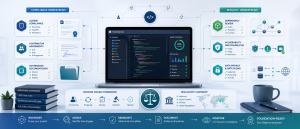
Open Source Project Compliance & Governance Review
Open-source projects pursuing foundation-level graduation undergo rigorous security audits — but the compliance and governance layer is often unaddressed or handled ad hoc. Licensing structure, contributor frameworks, vulnerability disclosure processes, data handling practices, and organizational governance are all evaluated during due diligence. Projects that fail on governance maturity waste time and credibility even when the code passes security review.
This practice provides the compliance and governance component — scoped to the specific project and foundation framework — as part of a combined security-and-compliance engagement.
What This Practice Covers
License compliance review. Analyzing project licensing structure, dependency license compatibility, and contributor license agreements (CLAs/DCOs) against foundation requirements. Identifying conflicts between project licenses and upstream or downstream dependencies before they become due diligence findings.
Contributor agreement frameworks. Drafting or reviewing CLAs, DCO policies, and IP assignment structures for compliance with foundation governance standards. Ensuring that the contributor framework supports the project’s licensing model and is enforceable across jurisdictions.
Vulnerability disclosure policy review. Evaluating whether the project’s CVE handling, disclosure timelines, and coordination processes meet foundation and industry expectations. Reviewing alignment with documented standards and identifying gaps before the due diligence review surfaces them.
Data handling and privacy framework assessment. Reviewing how the project handles telemetry, user data, and third-party data flows against applicable regulatory requirements. This is particularly relevant for projects targeting adoption in regulated sectors where data handling practices are a procurement prerequisite.
Organizational governance documentation. Reviewing or developing the governance documents, maintainer policies, escalation procedures, and decision-making frameworks that foundations evaluate during due diligence. Ensuring that governance documentation reflects actual project operations rather than aspirational statements.
Regulatory alignment. Identifying sector-specific regulatory obligations — financial services, healthcare, government procurement — that may affect the project’s compliance posture as it moves from community adoption to production deployment in regulated environments.
Background
Ron Cook has operated at the intersection of technology and law for over twenty years. Before practicing law, he built and ran a Microsoft Gold Certified Partner firm, earned Microsoft Certified Systems Engineer (MCSE), Microsoft Certified Systems Administrator (MCSA), and Microsoft Certified Trainer (MCT) certifications, and holds a CompTIA Certified Technical Trainer (CTT+) designation. He has attended multiple Microsoft annual conventions and has direct experience with enterprise infrastructure deployment, systems administration, and technical training at scale.
He holds a J.D., dual LL.M. degrees (Bankruptcy and Taxation), and an MBA — a combination that allows him to evaluate open-source project governance not only from a legal compliance perspective but with an understanding of how these projects are actually built, deployed, and maintained in production environments.
Engagement Model
Engagements are scoped to the specific project and governance framework. Work is delivered on a flat-fee or project basis, coordinated with the project’s technical security audit team. The compliance and governance review runs parallel to the security audit — not sequentially — so the project receives a unified assessment rather than fragmented feedback across workstreams.
Resources
CNCF Project Lifecycle & Graduation Criteria
CNCF Graduation Application Template
Linux Foundation
Contact
Ronald S. Cook
Ron@RonCookLawFirm.com
(888) 275-2620

